|
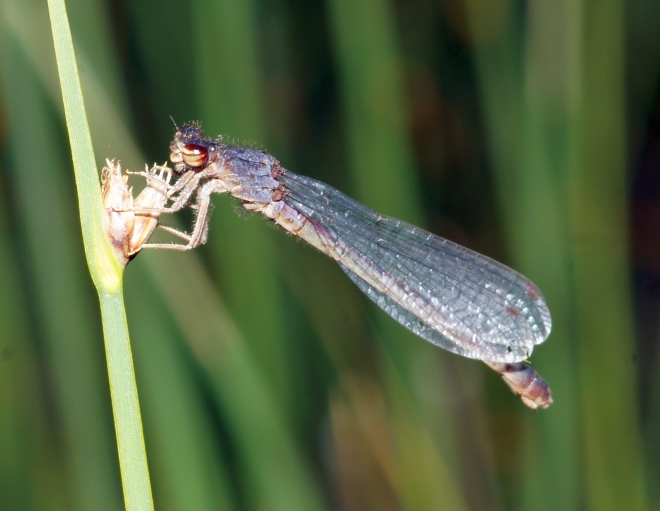
Common Name: Western Red Damsel Latin Name:
Amphiagrion abbreviatum Selys, 1876
(R.
Bercha, det.)
Length: 43 - 55 mm
Range: Alberta
Habitat:
Spring or canal fed marsh or seep
Time of year seen: June to
July (Additional Sightings)
Diet: Insects
Other: Amphiagrion abbreviatum (Selys),
the Western Red Damselfly, is a locally common species found in the southern
parts of British Columbia, Alberta and Saskatchewan in Canada (Walker, 1953
and Cannings, 2002). The damselflies are easily identified by their
coloration, hairiness and robust appearance (Walker, 1953). The males have a
black head and thorax and predominantly red abdomen. The females are
typically more orange in coloration and have lighter coloration then the
males (Acorn, 2004). The required habitat conditions include: a reliable
source of cool water with low TDS such as a spring or canal, an open marsh
or seep with inflow and outflow with minimal accumulation of dissolved
solids, areas within the marsh or seep with cool water temperatures (less
than 18'C and, based on Acorn (2004), perhaps as cold as 6'C), mixed
substrates with some bare areas, emergent marsh vegetation of bulrushes
and/or cattails, and surrounding terrestrial grass for perching (Bercha,
2022). |